SyncLib
Powerful Serializers for the Real WorldSyncLib is a .NET system for projects where traditional attribute-based serialization falls flat, forcing you to use DTOs. Use it when you want to save or transmit data with
- Type conversions (below: Color <=> string, and BMultiMap <=> List)
- Nonlocal representation changes (Start + End Date <=> Start Date + Duration)
- Backward compatibility
- Serializing the same type in multiple ways depending on context
- Multiple technologies without changing your serializers (JSON, binary, protocol buffers)
SyncLib does it all in half as many lines of code as DTO-based solutions (SyncLib version at left)
SyncLib — 83 lines
public class CalendarSync
{
  // Note: The serialized form does not include the Calendar.Id but it's included
  //       in the Web API's URL. The web controller will save that Calendar Id here.
  public int CalendarId { get; set; }
  public int ApiVersion { get; set; } = 2;

  public SyncJson.Options Options = new SyncJson.Options { NameConverter = SyncJson.ToCamelCase };

  public string Serialize(Calendar calendar) => SyncJson.WriteStringI(calendar, Sync, Options);
  public Calendar? Deserialize(string json) => SyncJson.ReadI<Calendar>(json, Sync, Options);

  public Calendar Sync(ISyncManager sm, Calendar? calendar)
  {
    _calendar = calendar ??= new Calendar { Id = CalendarId };

    if (ApiVersion >= 2)
      calendar.DefaultColor = sm.Sync("DefColor", calendar.DefaultColor, new SyncColor<ISyncManager>());

    // Serialize (save) or deserialize (load). It's saved as a simple list of
    // entries, while in memory we have a more complex dictionary data structure.
    IReadOnlyCollection<CalendarEntry> entries = calendar.Entries.Select(p => p.Value);
    var entriesOut = sm.SyncColl("Entries", entries, SyncEntry, ObjectMode.Normal)!;
    if (sm.IsReading) {
      calendar.Entries.Clear();
      foreach (var entry in entriesOut)
        calendar.Entries.Add(entry.StartTime, entry);
    }

    calendar.UserId = sm.Sync("UserId", calendar.UserId);

    return calendar;
  }

  private Calendar? _calendar;

  private CalendarEntry SyncEntry(ISyncManager sm, CalendarEntry? entry)
  {
    entry ??= new CalendarEntry { Id = CalendarId };

    if (ApiVersion >= 2) {
      entry.Duration = sm.SyncTimeAsString("Duration", entry.Duration);
      entry.Color    = sm.Sync("Color", entry.Color, new SyncColor<ISyncManager>());
    }

    entry.Calendar  ??= _calendar;
    entry.CalendarId  = entry.Calendar!.Id;
    entry.Id          = sm.Sync("Id", entry.Id);
    entry.Description = sm.Sync("Description", entry.Description) ?? "";
    entry.StartTime   = sm.SyncDateAsString("StartTime", entry.StartTime);
    entry.Location    = sm.Sync("Location", entry.Location) ?? "";
    entry.AdvanceReminder = sm.SyncTimeAsString("AdvanceReminder", entry.AdvanceReminder);

    if (ApiVersion <= 1) {
      // API version 1 has an EndTime field instead of a Duration field
      var end = sm.SyncDateAsString("EndTime", entry.StartTime.Add(entry.Duration));
      if (sm.IsReading)
        entry.Duration = end.Subtract(entry.StartTime);
    }

    return entry;
  }
}

// A custom synchronizer for Color values (it saves them in hex, e.g. "#446688")
public struct SyncColor<SM> : ISyncField<SM, Color> where SM : ISyncManager
{
  public Color Sync(ref SM sm, FieldId name, Color color)
  {
    var str = sm.Sync(name, ToString(color));
    if (str == null)
      throw new FormatException("Got null when a color was expected");
    return ToColor(str);
  }

  public static string ToString(Color c) => "#" + (c.ToArgb() & 0xFFFFF).ToString("X6");
  public static Color ToColor(string? s)
  {
    if (s == null || !s.StartsWith("#"))
      throw new FormatException("Expected a color (starting with '#')");
    return Color.FromArgb(Convert.ToInt32(s.Substring(1), 16));
  }
}
Traditional (Newtonsoft.Json DTOs) — 166 lines
public class JsonCalendar
{
  public IEnumerable<JsonCalendarEntry?>? Entries { get; set; }
  public int UserId { get; set; }
}

public class JsonCalendarV2 : JsonCalendar
{
  public string? DefColor { get; set; }
  public new IEnumerable<JsonCalendarEntryV2?>? Entries { get; set; }
}

public class JsonCalendarEntry
{
  public int Id { get; set; }
  public string? Description { get; set; }
  public DateTime StartTime { get; set; }
  public string? Location { get; set; }
  public TimeSpan? AdvanceReminder { get; set; }
  public virtual DateTime EndTime { get; set; }
}

public class JsonCalendarEntryV2 : JsonCalendarEntry
{
  [JsonIgnore]
  public override DateTime EndTime { get; set; }
  public TimeSpan Duration { get; set; }
  public string? Color { get; set; }
}

public class JsonCalendarSerialization
{
  // Note: The serialized form does not include the Calendar.Id but it's included
  //       in the Web API's URL. The web controller will save that Calendar Id here.
  public int CalendarId { get; set; }
  public int ApiVersion { get; set; } = 2;

  private JsonSerializer _serializer = new JsonSerializer {
    Formatting = Formatting.Indented,
    PreserveReferencesHandling = PreserveReferencesHandling.None,
    ContractResolver = new DefaultContractResolver()
    {
      NamingStrategy = new CamelCaseNamingStrategy()
    }
  };

  public string Serialize(Calendar calendar)
  {
    var sb = new StringBuilder();
    using (var writer = new StringWriter(sb))
      _serializer.Serialize(writer, ToJsonCalendar(calendar));

    return sb.ToString();
  }

  public Calendar? Deserialize(string json)
  {
    var expectedType = ApiVersion >= 2 ? typeof(JsonCalendarV2) : typeof(JsonCalendar);
    var calendar = _serializer.Deserialize(new StringReader(json), expectedType);

    return calendar == null ? null : FromJsonCalendar((JsonCalendar) calendar);
  }

  #region Code to convert Calendar to JsonCalendar for serialization

  public JsonCalendar ToJsonCalendar(Calendar calendar)
  {
    var jsonEntries = calendar.Entries.Select(pair => ToJsonCalendarEntry(pair.Value));

    if (ApiVersion <= 1) {
      return new JsonCalendar {
        UserId = calendar.UserId,
        Entries = jsonEntries,
      };
    } else {
      return new JsonCalendarV2 {
        UserId = calendar.UserId,
        Entries = jsonEntries.Cast<JsonCalendarEntryV2>(),
        DefColor = ToString(calendar.DefaultColor),
      };
    }
  }

  private JsonCalendarEntry ToJsonCalendarEntry(CalendarEntry entry)
  {
    JsonCalendarEntry jsonEntry;
    if (ApiVersion <= 1) {
      jsonEntry = new JsonCalendarEntry() {
        EndTime = entry.StartTime.Add(entry.Duration)
      };
    } else {
      jsonEntry = new JsonCalendarEntryV2 {
        Duration = entry.Duration,
        Color = ToString(entry.Color)
      };
    }

    jsonEntry.Id = entry.Id;
    jsonEntry.Description = entry.Description;
    jsonEntry.StartTime = entry.StartTime;
    jsonEntry.Location = entry.Location;
    jsonEntry.AdvanceReminder = entry.AdvanceReminder;

    return jsonEntry;
  }

  #endregion

  #region Code to convert JsonCalendar to Calendar after deserialization

  private Calendar FromJsonCalendar(JsonCalendar jsonCalendar)
  {
    _calendar = new Calendar() {
      Id = this.CalendarId,
      UserId = jsonCalendar.UserId,
      Entries = new BMultiMap<DateTime, CalendarEntry>()
    };

    var entries = jsonCalendar.Entries ?? (jsonCalendar as JsonCalendarV2)?.Entries;
    if (entries == null)
      throw new FormatException("Missing calendar entries");

    foreach (var entry in entries)
      _calendar.Entries[entry!.StartTime].Add(FromJsonCalendarEntry(entry!));

    if (jsonCalendar is JsonCalendarV2 v2) {
      _calendar.DefaultColor = ToColor(v2.DefColor);
    }

    return _calendar;
  }

  private Calendar? _calendar;

  private CalendarEntry FromJsonCalendarEntry(JsonCalendarEntry jsonEntry)
  {
    var entry = new CalendarEntry();

    entry.Calendar = _calendar;
    entry.CalendarId = _calendar!.Id;
    entry.Id = jsonEntry.Id;
    entry.Description = jsonEntry.Description ?? "";
    entry.StartTime = jsonEntry.StartTime;
    entry.Location = jsonEntry.Location ?? "";
    entry.AdvanceReminder = jsonEntry.AdvanceReminder;

    if (jsonEntry is JsonCalendarEntryV2 v2) {
      entry.Color = ToColor(v2.Color);
      entry.Duration = v2.Duration;
    } else {
      entry.Duration = jsonEntry.EndTime.Subtract(jsonEntry.StartTime);
    }

    return entry;
  }

  #endregion

  public static string ToString(Color c) => "#" + (c.ToArgb() & 0xFFFFF).ToString("X6");
  public static Color ToColor(string? s)
  {
    if (s == null || !s.StartsWith("#"))
      throw new FormatException("Expected a color (starting with '#')");
    return Color.FromArgb(Convert.ToInt32(s.Substring(1), 16));
  }
}
Shared business classes (Calendar and CalendarEntry) are the same for both and not shown. See the full runnable example in HomePageCalendarExample.cs.
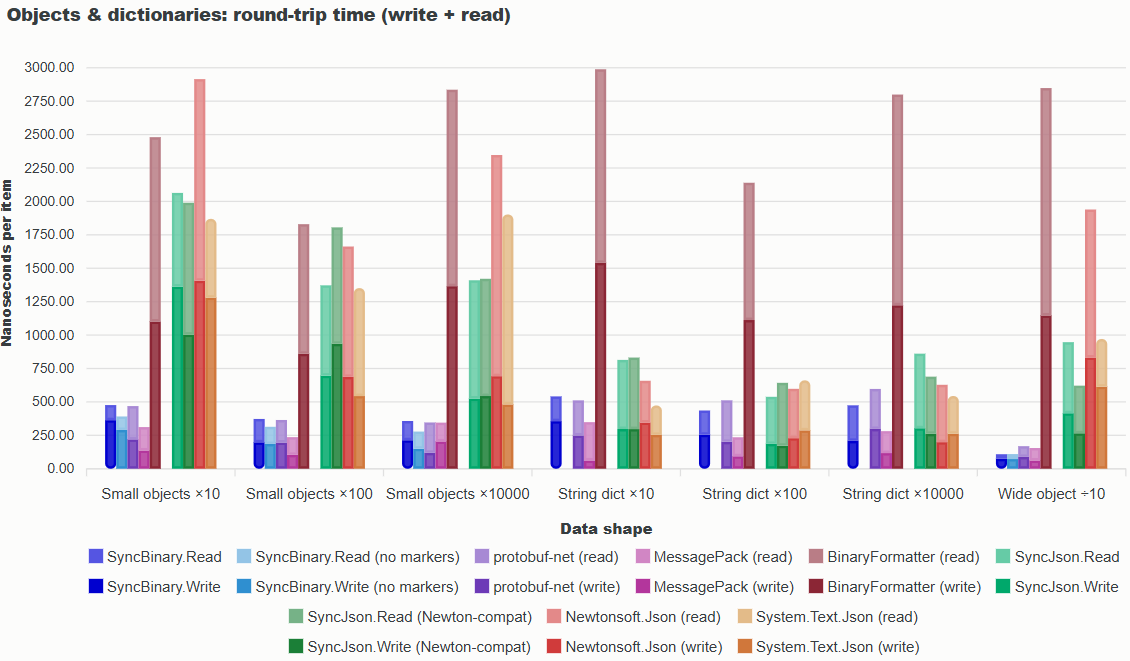
And it’s fast!
Within each group of bars, binary serializers are on the left and plain-text serializers are on the right. SyncLib serializers are blue/green.


For more, read the SyncLib manual.